
In questa pagina
5 Tipi di supporto
Panoramica
I tipi di supporto sono exported con tutti i relativi oggetti e relazioni tra oggetti.
Esportazione
Per esportare i tipi di supporto, procedi come segue:
- Vai a: Amministrazione → tipi di supporto
- Contrassegnare le caselle dei template da esportare
- Clicca su Esporta sotto l'elenco
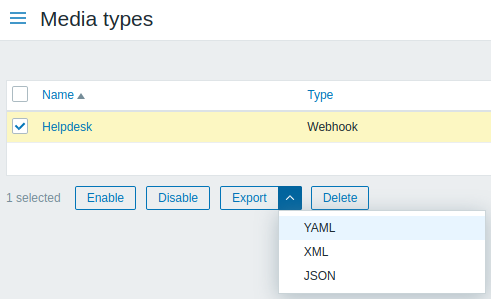
A seconda del formato selezionato, i template vengono esportati in un file locale con un nome predefinito:
- zabbix_export_mediatypes.yaml - nell'esportazione YAML (opzione predefinita per l'esportazione)
- zabbix_export_mediatypes.xml - nell'esportazione XML
- zabbix_export_mediatypes.json - nell'esportazione JSON
Importazione
per importare i tipi di supporto, procedi come segue:
- Vai a: Amministrazione → Tipi di supporto
- fare click su Importa a destra
- Seleziona file da importare
- Contrassegna le opzioni richieste nelle regole di importazione
- Clicca su Importa
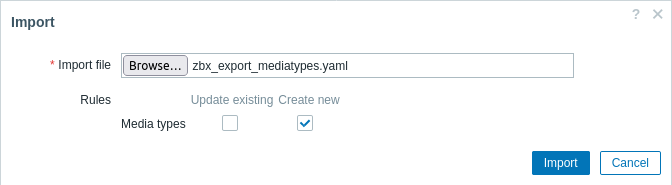
Un messaggio di successo o di fallimento dell'importazione sarà visualizzato nel frontend.
Regole di importazione:
| Regola | Descrizione |
|---|---|
| Aggiorna esistente | Gli elementi esistenti verranno aggiornati con i dati presi dal file importato. In caso contrario non verranno aggiornati. |
| Crea nuovo | L'importazione aggiungerà nuovi alimenti utilizzando i dati del file importato. Altrimenti non verranno aggiunti. |
| Elimina mancante | L'importazione rimuoverò gli elementi esistenti non presenti nel file importato. Altrimenti non verranno rimossi. |
Formato di Esportazione
Esportazione in YAML:
zabbix_export:
  version: '6.0'
  date: '2021-08-31T13:34:17Z'
  media_types:
    -
      name: Pushover
      type: WEBHOOK
      parameters:
        -
          name: endpoint
          value: 'https://api.pushover.net/1/messages.json'
        -
          name: eventid
          value: '{EVENT.ID}'
        -
          name: event_nseverity
          value: '{EVENT.NSEVERITY}'
        -
          name: event_source
          value: '{EVENT.SOURCE}'
        -
          name: event_value
          value: '{EVENT.VALUE}'
        -
          name: expire
          value: '1200'
        -
          name: message
          value: '{ALERT.MESSAGE}'
        -
          name: priority_average
          value: '0'
        -
          name: priority_default
          value: '0'
        -
          name: priority_disaster
          value: '0'
        -
          name: priority_high
          value: '0'
        -
          name: priority_information
          value: '0'
        -
          name: priority_not_classified
          value: '0'
        -
          name: priority_warning
          value: '0'
        -
          name: retry
          value: '60'
        -
          name: title
          value: '{ALERT.SUBJECT}'
        -
          name: token
          value: '<PUSHOVER TOKEN HERE>'
        -
          name: triggerid
          value: '{TRIGGER.ID}'
        -
          name: url
          value: '{$ZABBIX.URL}'
        -
          name: url_title
          value: Zabbix
        -
          name: user
          value: '{ALERT.SENDTO}'
      max_sessions: '0'
      script: |
        try {
            var params = JSON.parse(value),
                request = new HttpRequest(),
                data,
                response,
                severities = [
                    {name: 'not_classified', color: '#97AAB3'},
                    {name: 'information', color: '#7499FF'},
                    {name: 'warning', color: '#FFC859'},
                    {name: 'average', color: '#FFA059'},
                    {name: 'high', color: '#E97659'},
                    {name: 'disaster', color: '#E45959'},
                    {name: 'resolved', color: '#009900'},
                    {name: 'default', color: '#000000'}
                ],
                priority;

            if (typeof params.HTTPProxy === 'string' && params.HTTPProxy.trim() !== '') {
                request.setProxy(params.HTTPProxy);
            }

            if ([0, 1, 2, 3].indexOf(parseInt(params.event_source)) === -1) {
                throw 'Incorrect "event_source" parameter given: "' + params.event_source + '".\nMust be 0-3.';
            }

            if (params.event_value !== '0' && params.event_value !== '1'
                && (params.event_source === '0' || params.event_source === '3')) {
                throw 'Incorrect "event_value" parameter given: ' + params.event_value + '\nMust be 0 or 1.';
            }

            if ([0, 1, 2, 3, 4, 5].indexOf(parseInt(params.event_nseverity)) === -1) {
                params.event_nseverity = '7';
            }

            if (params.event_value === '0') {
                params.event_nseverity = '6';
            }

            priority = params['priority_' + severities[params.event_nseverity].name] || params.priority_default;

            if (isNaN(priority) || priority < -2 || priority > 2) {
                throw '"priority" should be -2..2';
            }

            if (params.event_source === '0' && isNaN(params.triggerid)) {
                throw 'field "triggerid" is not a number';
            }

            if (isNaN(params.eventid)) {
                throw 'field "eventid" is not a number';
            }

            if (typeof params.message !== 'string' || params.message.trim() === '') {
                throw 'field "message" cannot be empty';
            }

            data = {
                token: params.token,
                user: params.user,
                title: params.title,
                message: params.message,
                url: (params.event_source === '0')
                    ? params.url + '/tr_events.php?triggerid=' + params.triggerid + '&eventid=' + params.eventid
                    : params.url,
                url_title: params.url_title,
                priority: priority
            };

            if (priority == 2) {
                if (isNaN(params.retry) || params.retry < 30) {
                    throw 'field "retry" should be a number with value of at least 30 if "priority" is set to 2';
                }

                if (isNaN(params.expire) || params.expire > 10800) {
                    throw 'field "expire" should be a number with value of at most 10800 if "priority" is set to 2';
                }

                data.retry = params.retry;
                data.expire = params.expire;
            }

            data = JSON.stringify(data);
            Zabbix.log(4, '[ Pushover Webhook ] Sending request: ' + params.endpoint + '\n' + data);

            request.addHeader('Content-Type: application/json');
            response = request.post(params.endpoint, data);

            Zabbix.log(4, '[ Pushover Webhook ] Received response with status code ' + request.getStatus() + '\n' + response);

            if (response !== null) {
                try {
                    response = JSON.parse(response);
                }
                catch (error) {
                    Zabbix.log(4, '[ Pushover Webhook ] Failed to parse response received from Pushover');
                    response = null;
                }
            }

            if (request.getStatus() != 200 || response === null || typeof response !== 'object' || response.status !== 1) {
                if (response !== null && typeof response === 'object' && typeof response.errors === 'object'
                        && typeof response.errors[0] === 'string') {
                    throw response.errors[0];
                }
                else {
                    throw 'Unknown error. Check debug log for more information.';
                }
            }

            return 'OK';
        }
        catch (error) {
            Zabbix.log(4, '[ Pushover Webhook ] Pushover notification failed: ' + error);
            throw 'Pushover notification failed: ' + error;
        }
      description: |
        Gentilmente fare riferimento alla guida: https://git.zabbix.com/projects/ZBX/repos/zabbix/browse/templates/media/pushover

        Set token parameter with to your Pushover application key.
        When assigning Pushover media to the Zabbix user - add user key into send to field.
      message_templates:
        -
          event_source: TRIGGERS
          operation_mode: PROBLEM
          subject: 'Problem: {EVENT.NAME}'
          message: |
            Problem started at {EVENT.TIME} on {EVENT.DATE}
            Problem name: {EVENT.NAME}
            Host: {HOST.NAME}
            Severity: {EVENT.SEVERITY}
            Operational data: {EVENT.OPDATA}
            Original problem ID: {EVENT.ID}
            {TRIGGER.URL}
        -
          event_source: TRIGGERS
          operation_mode: RECOVERY
          subject: 'Resolved in {EVENT.DURATION}: {EVENT.NAME}'
          message: |
            Problem has been resolved at {EVENT.RECOVERY.TIME} on {EVENT.RECOVERY.DATE}
            Problem name: {EVENT.NAME}
            Problem duration: {EVENT.DURATION}
            Host: {HOST.NAME}
            Severity: {EVENT.SEVERITY}
            Original problem ID: {EVENT.ID}
            {TRIGGER.URL}
        -
          event_source: TRIGGERS
          operation_mode: UPDATE
          subject: 'Updated problem in {EVENT.AGE}: {EVENT.NAME}'
          message: |
            {USER.FULLNAME} {EVENT.UPDATE.ACTION} problem at {EVENT.UPDATE.DATE} {EVENT.UPDATE.TIME}.
            {EVENT.UPDATE.MESSAGE}

            Current problem status is {EVENT.STATUS}, age is {EVENT.AGE}, acknowledged: {EVENT.ACK.STATUS}.
        -
          event_source: DISCOVERY
          operation_mode: PROBLEM
          subject: 'Discovery: {DISCOVERY.DEVICE.STATUS} {DISCOVERY.DEVICE.IPADDRESS}'
          message: |
            Discovery rule: {DISCOVERY.RULE.NAME}

            Device IP: {DISCOVERY.DEVICE.IPADDRESS}
            Device DNS: {DISCOVERY.DEVICE.DNS}
            Device status: {DISCOVERY.DEVICE.STATUS}
            Device uptime: {DISCOVERY.DEVICE.UPTIME}

            Device service name: {DISCOVERY.SERVICE.NAME}
            Device service port: {DISCOVERY.SERVICE.PORT}
            Device service status: {DISCOVERY.SERVICE.STATUS}
            Device service uptime: {DISCOVERY.SERVICE.UPTIME}
        -
          event_source: AUTOREGISTRATION
          operation_mode: PROBLEM
          subject: 'Autoregistration: {HOST.HOST}'
          message: |
            Host name: {HOST.HOST}
            Host IP: {HOST.IP}
            Agent port: {HOST.PORT}
Tag dell'elemento
I valori dei tag dell'elemento sono spiegati nella tabella seguente.
| Elemento | Proprietà elemento | Obbligatorio | Tipo | Intervallo[1](#note a piè di pagina) | Descrizione |
|---|---|---|---|---|---|
| media_tipi | - | Elemento radice per media_tipi. | |||
| nome | x | stringa |
Nome del tipo di supporto. | ||
| type | x | string |
0 - EMAIL 1 - SMS 2 - SCRIPT 4 - WEBHOOK |
Trasporto utilizzato dal tipo di supporto. | |
| status | - | string |
0 - ABILITATO (predefinito) 1 - DISABILITATO |
Se il tipo di supporto è abilitato. | |
| max_sessions | - | intero |
Valori possibili per SMS: 1 - (predefinito) Valori possibili per altri tipi di media: 0-100, 0 - illimitato |
Il numero massimo di avvisi che possono essere elaborati in parallelo. | |
| attempts | - | intero |
1-10 (predefinito: 3) | Il numero massimo di tentativi per inviare un avviso. | |
| attempt_interval | - | string |
0-60s (predefinito: 10s) | L'intervallo tra i tentativi di nuovo. Accetta secondi e unità di tempo con suffisso. |
|
| descrizione | - | stringa |
Descrizione del tipo di supporto. | ||
| messaggio_modelli | - | Elemento radice per modelli di messaggi di tipo multimediale. | |||
| event_source | x | string |
0 - TRIGGERS 1 - DISCOVERY 2 - AUTOREGISTRATION 3 - INTERNAL |
Fonte evento. | |
| operazione_mode | x | string |
0 - PROBLEMA 1 - RECUPERO 2 - AGGIORNAMENTO |
Modalità di funzionamento. | |
| oggetto | - | stringa |
Oggetto del messaggio. | ||
| messaggio | - | stringa |
Corpo del messaggio. | ||
| Utilizzato solo dal tipo di supporto e-mail | |||||
| smtp_server | x | stringa |
Server SMTP. | ||
| smtp_port | - | integer |
Predefinito: 25 | Porta del server SMTP a cui connettersi. | |
| smtp_helo | x | stringa |
Chiamata SMTP. | ||
| smtp_email | x | stringa |
Indirizzo e-mail da cui verranno inviate le notifiche. | ||
| smtp_security | - | string |
0 - NONE (predefinito) 1 - STARTTLS 2 - SSL_OR_TLS |
Livello di sicurezza della connessione SMTP da utilizzare. | |
| smtp_verify_host | - | string |
0 - NO (predefinito) 1 - SÌ |
Host di verifica SSL per SMTP. Facoltativo se smtp_security è STARTTLS o SSL_OR_TLS. | |
| smtp_verify_peer | - | string |
0 - NO (predefinito) 1 - SÌ |
Peer di verifica SSL per SMTP. Facoltativo se smtp_security è STARTTLS o SSL_OR_TLS. | |
| smtp_authentication | - | string |
0 - NESSUNO (predefinito) 1 - PASSWORD |
Metodo di autenticazione SMTP da utilizzare. | |
| nomeutente | - | stringa |
Nome utente. | ||
| password | - | stringa |
Password di autenticazione. | ||
| content_type | - | string |
0 - TESTO 1 - HTML (predefinito) |
Formato messaggio. | |
| Utilizzato solo dal tipo di supporto SMS | |||||
| gsm_modem | x | stringa |
Nome dispositivo seriale del modem GSM. | ||
| Utilizzato solo dal tipo di supporto script | |||||
| nome script | x | stringa |
Nome script. | ||
| parametri | - | Elemento radice per parametri di script. | |||
| Utilizzato solo dal tipo di supporto webhook | |||||
| script | x | stringa |
Sceneggiatura. | ||
| timeout | - | string |
1-60s (predefinito: 30s) | Intervallo di timeout della richiesta HTTP script JavaScript. | |
| process_tags | - | string |
0 - NO (predefinito) 1 - YES |
Se elaborare i tag restituiti. | |
| show_event_menu | - | string |
0 - NO (predefinito) 1 - YES |
Se {EVENT.TAGS.*} è stato risolto con successo in event_menu_url e event_menu\ _name campi, questo campo indica la presenza di una voce nel menu dell'evento. | |
| evento_menu_url | - | string |
URL della voce del menu dell'evento. Supporta la macro {EVENT.TAGS.*}. | ||
| evento_menu_nome | - | stringa |
Nome della voce del menu dell'evento. Supporta la macro {EVENT.TAGS.*}. | ||
| parametri | - | Elemento radice per i parametri del tipo di supporto webhook. | |||
| nome | x | stringa |
Nome parametro webhook. | ||
| valore | - | stringa |
Valore parametro webhook. | ||
Note a piè di pagina
1 Per i valori di stringa, verrà esportata solo la stringa (ad es. "EMAIL") senza la numerazione utilizzata in questa tabella. I numeri per l'intervallo valori (corrispondenti ai valori API) in questa tabella viene utilizzato per solo ordinazione.